
Last Updated: November 21, 2026
Quick Summary
To find the cause of a washer leaking water, first match where the water appears and which cycle stage it happens in to the likely part. Leaks during fill point to supply hoses, the inlet valve, or water supply connections, while leaks during wash suggest the door gasket, tub seal, or detergent dispenser. Shut off the water valves and unplug the washer before inspecting anything.
- Water at the front of a front-loader usually points to the door gasket.
- Leaks during spin suggest the drain pump, drain hose, or a loose connection.
- A washer leaking when off often means the inlet valve no longer closes fully.
- Leave a 4-inch air gap between the drain hose end and the standpipe.
- Call a pro for tub seal, drain pump, or inlet valve repairs.
Table of Contents
- Locate the Leak Before You Do Anything Else
- Why Is My Washer Leaking Water From the Bottom?
- Water Leaking From Bottom of Washing Machine When Filling
- Washing Machine Leaking From Underneath When Spinning
- Water Leaking From Washing Machine When Not in Use
- Door Gasket, Tub Seal, and Drain Pump Failures
- When to Call a Professional in Tampa
- Book a Same-Day Washer Diagnostic
- Frequently Asked Questions
Locate the Leak Before You Do Anything Else
If you’re asking why is my washer leaking water, the answer starts with location. Where the water lands tells you more than any guess about parts.
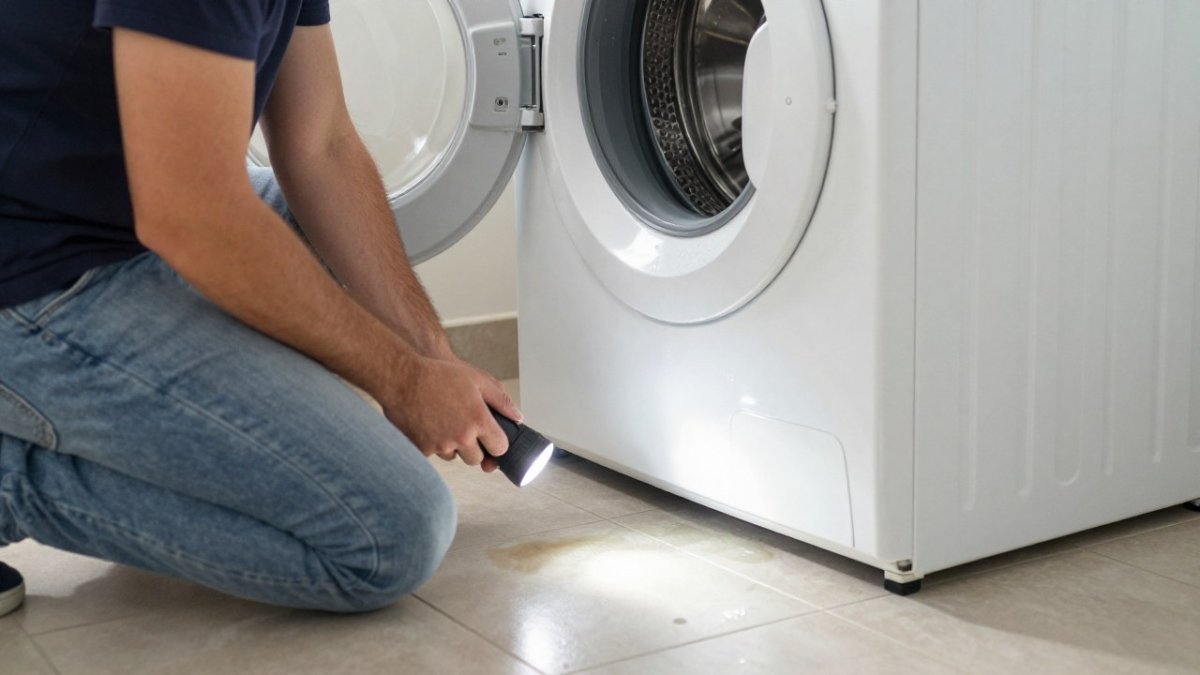
Before you inspect anything, make the area safe. Water and electricity are a bad combination, and a laundry room often has outlets, a utility sink, and a washer motor all within a few feet of the puddle.
Stop the Water and Power First
- Shut off the two water supply valves behind the washer (usually labeled hot and cold). Turn them clockwise until they stop. If they are stiff or won’t close fully, that alone may be your leak source.
- Unplug the washer from the wall outlet. Do not pull the cord by the cable; grip the plug body. If the outlet or plug is wet, do not touch it, shut off the circuit at the breaker panel first.
- If water is near an outlet, extension cord, or power strip, cut power to that circuit at the panel before you mop up.
- Contain the water with towels or a wet/dry shop vacuum. On tile or vinyl, water can wick under baseboards and into the subfloor within hours; on hardwood, it can cup the boards. Pull up any rug or mat so the floor can dry.
Watch out: never stand in standing water while touching a plugged-in appliance or an outlet. If you cannot safely reach the plug, stop and call a licensed technician.
Match the Water Location to the Source
Water pooling at the front of a front-load washer usually points to the door gasket. Water under the middle of the machine often means a tub seal or drain pump issue.
Wipe up excess water first. Then watch where it reappears. A dry paper towel placed under the front, middle, and back of the machine will show you the first wet point faster than a visual scan.
Match the Cycle Stage to the Source
When the leak happens matters as much as where.
- Leaks during fill: supply hoses, inlet valve, or water supply connections
- Leaks during wash: door gasket, tub seal, or detergent dispenser
- Leaks during spin: drain pump, drain hose, or a loose connection under vibration
- Leaks when off: a slow supply-line drip or a valve that won’t fully close
- Leaks only on the rinse cycle: a drain hose that is pushed too far into the standpipe, causing water to siphon or back up
Run one short cycle at a time, fill only, then wash, then spin, and check the paper towels between stages.
For a broader look at common causes, our guide on what causes washer leaks covers the full list before you dig in.
Match where and when the water appears to the part most likely to blame.
| Cycle stage | Likely source |
|---|---|
| Leaks during fill | Supply hoses, inlet valve, or water supply connections |
| Leaks during wash | Door gasket, tub seal, or detergent dispenser |
| Leaks during spin | Drain pump, drain hose, or a loose connection under vibration |
| Leaks when off | A slow supply-line drip or a valve that won’t fully close |
| Leaks only on the rinse cycle | Drain hose pushed too far into the standpipe |
Why Is My Washer Leaking Water From the Bottom?
Water leaking from the bottom of a washing machine almost always comes from four places: the hoses, the inlet valve, the drain pump, or a worn internal seal. For a deeper walkthrough of each cause, see why is my washing machine leaking from bottom. Start with the parts you can see and reach.
Check the Fill and Drain Hoses First
The fill hose and drain hose are the most common culprits, and the easiest to check. Pull the washer out gently and look behind it.
- Look for a cracked hose, a damaged hose, or a kinked hose
- Check each hose connection for a loose fit
- Feel along the hose for soft spots or bulges
A blocked hose can also back water up and push it out at a joint. If a hose looks worn, replace washer hoses rather than patching them.
Inspect the Water Inlet Valve and Supply Connections
The water inlet valve controls water coming into the machine. A faulty valve can drip even when the washer is off. Check the supply connections at the wall too. Hand-tighten any loose fitting, but don’t overtighten.
If water only appears at the back near the supply lines, the valve or supply connection is your likely source.
Water Leaking From Bottom of Washing Machine When Filling
Water leaking from bottom of washing machine when filling points to the fill side of the system. The machine is pulling in water, and something on that path is failing.
Common causes include:
- A loose water inlet hose connection at the valve or the wall
- A cracked fill hose near the coupling
- A faulty water inlet valve that drips under pressure
- A damaged water supply line behind the unit
Turn off the water at the wall valves before you inspect. Then dry the area and run a short fill cycle to watch for the first drip. That single step narrows it down fast.
Washing Machine Leaking From Underneath When Spinning
A washing machine leaking from underneath when spinning usually means vibration is shaking water past a loose joint or a worn part. Spin cycles stress the drain system hardest.
Check these first:
- The drain hose connection at the pump and at the standpipe
- The drain pump housing for cracks
- The tub seal, which can leak more as the drum moves
If the leak only shows up at high spin speed, the drain system is the prime suspect. Tighten connections and look for a damaged hose before assuming the pump is bad.
Water Leaking From Washing Machine When Not in Use
Water leaking from washing machine when not in use is a strong signal. The machine isn’t running, so the leak comes from pressure, not motion.
The usual cause is a water inlet valve that no longer closes fully. Water trickles past it and drips out. A slow supply-line drip can do the same. Shut off the wall valves when the washer sits idle, and have the valve checked.
Door Gasket, Tub Seal, and Drain Pump Failures
Front-load and top-load washers leak differently, so match the failure to your machine. Our guide on front load vs top load washer problems breaks down the differences.
On a front-loader, the door gasket and door seal are frequent leak points.
On any washer, a worn tub seal lets water past the drum. A failing drain pump or a blocked drain system pushes water out where it shouldn’t go.
When to Call a Professional in Tampa
Some leaks are a five-minute hose check. Others need the cabinet opened, and that’s your line. If you’ve tightened the connections and the washer leaking continues, or the leak comes from the tub seal or drain pump, call a pro.
DIY Versus Professional: Where the Line Sits
Low-risk checks you can do yourself: inspecting and replacing fill and drain hoses, hand-tightening supply connections, cleaning the door gasket and detergent dispenser, and clearing lint or debris from the drain hose and standpipe.
Stop and call a technician when the repair involves:
- The water inlet valve or any part behind the control panel (line voltage is present even when the washer is off)
- The drain pump housing or internal drain system
- The tub seal, tub bearing, or any repair that requires tilting or opening the cabinet
- A leak you cannot reproduce after two cycle tests
A common pattern is a homeowner who replaces a hose, then a valve, and still has water on the floor, because the real failure was a tub seal that only leaks under a full drum.
What Drives Repair Cost and Time
Repair pricing depends on the part, the labor to reach it, and the machine type. Hose and connection fixes are generally quicker than inlet valve or drain pump work, which often requires removing the cabinet or rear panel.
Ask for a diagnosis before authorizing work, and ask whether the quote includes the part and labor. When a repair becomes expensive relative to the cost of a new machine, it is worth comparing repair versus replacement, especially on an older washer.
Prevention: Stop the Next Leak
- Consider replacing rubber fill hoses periodically; braided stainless hoses are a more durable option.
- Check both hose connections twice a year for stiffness, bulging, or corrosion at the coupling.
- Leave a 4-inch air gap between the drain hose end and the standpipe, and secure the hose so it cannot fall out during spin.
- Use the right amount of high-efficiency detergent for a front-loader; excess suds stress the door gasket and can push water past the seal.
- Don’t overload the drum, an unbalanced load vibrates the machine and works connections loose.
We handle washing machine repair in Tampa Bay for homeowners across the area, and our technicians are licensed and insured. We offer free diagnostics with any repair, so you get a real answer before work starts.
Book a Same-Day Washer Diagnostic
You’ve located the leak and checked the easy fixes. We respond to appointment requests within one business day, and you can check what our diagnostic fee covers before you schedule.
Our EPA Clean Air section 608 certified techs work on a wide range of makes and models. We’re a local small business, and we treat your home like our own.
A leaking washer rarely fixes itself, and a slow drip can quietly damage your floors.
Frequently Asked Questions
Can I still use my washing machine if it’s leaking?
Stop using it until you find the source. A washer leaking water can damage flooring, subfloor, and drywall, and standing water near electrical components is a shock risk. Turn off both water supply valves behind the machine, unplug it, and wipe up excess water. If the leak is a loose hose connection, you may be able to fix it yourself in minutes. If water is coming from the tub seal, drain pump, or inlet valve, keep the machine off and have it inspected before running another load.
Why does my washer leak only when it is filling?
A leak that appears only during the filling cycle almost always points to the water supply side. Check the water inlet hoses at both ends for loose connections, cracked rubber, or missing washers. Look at the water inlet valve where the hoses connect to the back of the machine; a faulty valve can drip when pressurized. If water appears only when filling and stops afterward, the fill hose or inlet valve is the likely cause, not the tub or pump.
Why is water leaking from my washer when it is not in use?
Water leaking from a washing machine when not in use usually means a supply valve is not closing fully or a hose connection is under constant pressure. Since the hoses stay pressurized whenever the wall valves are open, a pinhole in a fill hose or a worn valve seat will drip around the clock. Shut off the wall valves between loads as a temporary measure, then have the inlet valve and hoses checked. This type of leak is easy to miss until it warps flooring.
How much does it cost to fix a washer leak?
Repair cost depends on the failed part and the machine model. A hose replacement is a low-cost fix, while a drain pump, tub seal, or inlet valve repair costs more because of parts and labor time. Tampa Bay Appliance Repair applies the diagnostic fee toward the repair when you proceed, so you get a real quote before work begins. Book online for a same-day appointment request and a clear price before any repair starts.
