
Last Updated: October 26, 2026
Quick Summary
Refrigerator clicking is usually normal when it is a single click that signals a switch or valve doing its job, but rapid repeated clicking with warm food points to a failing start relay or compressor. Time the clicks, check that the fridge is level, and confirm whether it still cools. If clicking is rapid, the compressor area is hot, and food is warming, unplug the unit and call a technician.
- A single click followed by quiet is normal, while rapid clicking that never stops means a part is failing.
- A click repeating every 30 seconds to a few minutes with no cooling often points to the start device.
- Unplug the refrigerator before removing any panel or inspecting the start relay.
- Warm fridge with a cold freezer suggests an airflow or defrost problem rather than a failed compressor.
- If the repair estimate approaches half the price of a comparable new unit on an old fridge, replacement usually wins.
Table of Contents
- Is Refrigerator Clicking Normal or a Sign of Trouble?
- A Safe, Ordered Diagnostic Workflow for Refrigerator Clicking
- Refrigerator Start Relay Clicking: What the Click Means
- Refrigerator Clicking but Not Cooling: The Symptom That Changes Everything
- Refrigerator Clicking Noise From Freezer: Ice Maker and Fan Clues
- Electrical and Compressor Safety Boundaries You Should Not Cross
- Repair or Replace? Weighing Cost Against Age and Risk
- Book a Free Diagnostic With a Licensed Technician
- Frequently Asked Questions
Is Refrigerator Clicking Normal or a Sign of Trouble?
A refrigerator clicking noise is usually a normal sign that a component is switching on or off, but repeated clicking paired with warm food points to a real problem.
Here is the key distinction most guides skip: a single click is normal, a loop of clicks is not.
- One click, then quiet: normal. A switch or valve did its job.
- A click every few minutes: often normal compressor cycling.
- Rapid clicking that never stops: a part is failing.
That last pattern is the one that matters. A refrigerator that clicks over and over is usually stuck in a failed start.
A Safe, Ordered Diagnostic Workflow for Refrigerator Clicking
Work through these steps in order. Each one narrows the sound source before you touch anything, and each has a clear stop point so you do not cross into sealed-system or electrical work.
Step 1: Listen and Map the Clicking Pattern
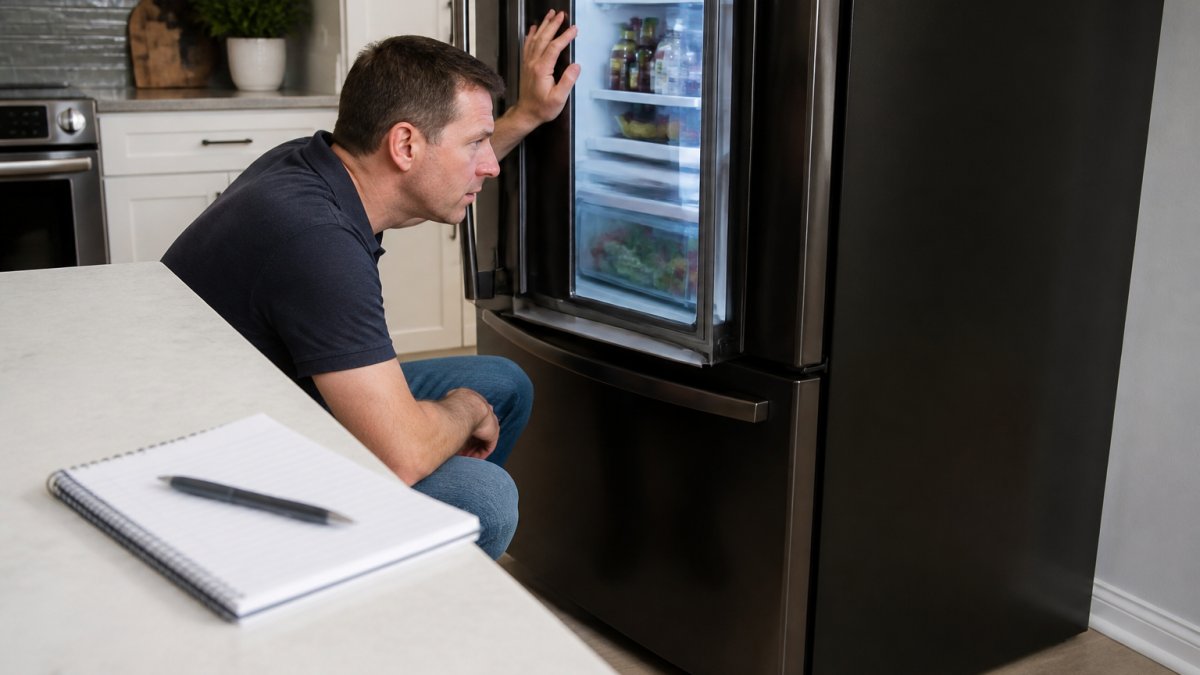
Start by timing the clicks with a phone stopwatch. Note how often they happen, whether the compressor hums between them, and whether the fridge cools in the gaps. This sound-pattern comparison is the fastest way to sort a harmless click from a failing part.
| Sound pattern | What it usually means | Urgency |
|---|---|---|
| One click, then quiet | A switch, valve, or thermostat did its job | Normal |
| Click every few minutes, fridge stays cold | Compressor cycling on and off | Usually normal |
| Click at startup, then a hum that cuts out | Start device trying and failing | Investigate soon |
| Rapid repeated clicking, no cooling | Failed start relay or compressor | Act now; food at risk |
| Click at regular intervals tied to ice production | Ice maker cycle or water valve | Usually normal |
Write down the pattern and the time between clicks. It tells you where to look next and gives a technician a head start.
A click repeating every 30 seconds to a few minutes with no cooling in between often points to the start device rather than the compressor itself. A click that repeats rapidly with a hot compressor area is the more serious pattern.
Step 2: Check the Easy Mechanical Causes
Before you suspect electronics, rule out the simple stuff. A fridge that is not level can vibrate and click against the floor, and a fan blade can strike ice or a bent panel.
- Check the refrigerator level with a spirit level and confirm all four feet sit flat.
- Clear anything touching the back or sides, including boxes and bags.
- Pull the unit out and check for debris, a bent back panel, or a fan blade contacting the shroud.
Step 3: Isolate the Sound Source Safely
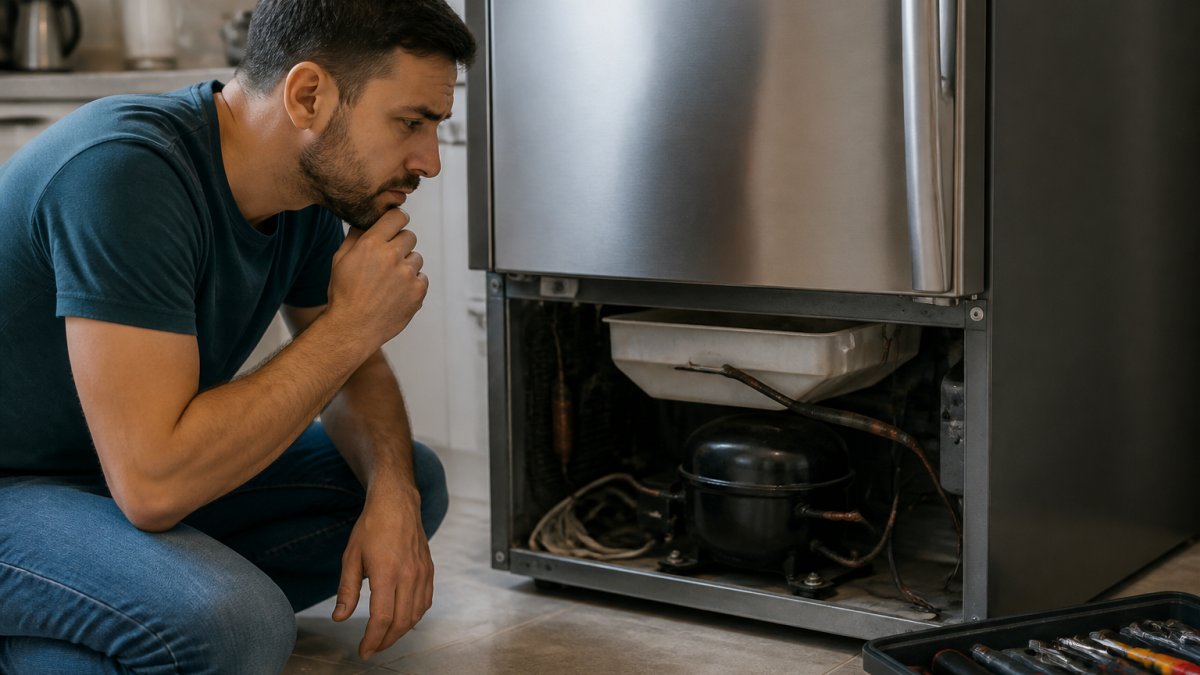
Trace the click to its source without touching wiring. Put your hand near, not on, the lower back panel and feel for a warm, clicking spot near the compressor area. In the freezer, listen near the ice maker and behind the rear wall for the evaporator fan.
- Lower back, warm spot: compressor or start device area.
- Upper freezer, near the ice maker: ice maker or water-supply valve.
- Behind the freezer wall: evaporator fan hitting ice.
Component locations vary by design, top-freezer, side-by-side, French-door, and built-in models route parts differently. Check your model manual for the exact layout before you remove any panel.
Unplug the refrigerator before removing any panel or inspecting the start relay. Never open the sealed compressor, touch wiring, or work near refrigerant lines. If you are unsure whether to keep going, our guide on DIY vs professional refrigerator repair explains where to stop.
Step 4: Pair the Click With Cooling Performance
A click alone is a sound; a click plus a temperature reading is a diagnosis. Check the fridge and freezer temperatures and note whether the compressor runs between clicks.
- Clicking, still cold: likely a start device, valve, or fan, often a modest repair.
- Clicking, warm fridge and cold freezer: airflow or defrost problem.
- Clicking, warm everywhere: start device or compressor failing to start.
If the clicks are rapid, the compressor area is hot, and the food is warming, stop troubleshooting and unplug the unit. That combination is the clearest signal that the start device or compressor has failed and the repair belongs with a qualified technician.
Refrigerator Start Relay Clicking: What the Click Means
A refrigerator start relay clicking is the most common cause of a repeating click. The start relay is the small device that gives the compressor a jolt to start.
The start relay is a small switch that powers the compressor at startup. When it wears out, it can no longer hold the circuit closed, so it clicks in a loop.
This is the classic failure pattern:
- The relay clicks.
- The compressor hums, then stops.
- The relay clicks again seconds later.
If the click sits at the back near the compressor, the start relay or start device is the prime suspect. For a deeper check on the compressor itself, see our guide on how to know if a refrigerator compressor is bad.
Refrigerator Clicking but Not Cooling: The Symptom That Changes Everything
A refrigerator clicking but not cooling moves this from a nuisance to a repair.
Check the temperature first. If the fridge section is warm and the freezer is soft, the cooling cycle has stopped.
- Warm fridge, cold freezer: airflow or defrost problem.
- Warm everywhere: compressor or start device issue.
- Clicking plus no cold at all: call a technician.
Do not keep opening the doors. Every opening lets cold air out and speeds spoilage. For a full fix path, follow our 7-step refrigerator not cooling guide.
Refrigerator Clicking Noise From Freezer: Ice Maker and Fan Clues
A refrigerator clicking noise from the freezer usually comes from the ice maker or a fan. The ice maker cycles a valve and motor, and each cycle makes a click.
Listen for where the sound lands:
- Upper freezer, near the ice maker: ice maker or water supply valve.
- Behind the freezer wall: evaporator fan hitting ice.
- Lower back: condenser fan or compressor area.
If the click ties to ice production, our ice maker troubleshooting guide walks through the fix. If ice has built up on the fan, defrost the unit fully and check for a blocked drain.
Electrical and Compressor Safety Boundaries You Should Not Cross
Some parts are safe to check. Others are not. Know the line before you start.
- Safe: leveling, cleaning coils, clearing obstructions, listening.
- Caution: unplugging and inspecting the start relay.
- Stop: opening the sealed compressor, touching wiring, or working near refrigerant lines.
Refrigerant work requires certification (the EPA). Our technicians hold EPA Clean Air Section 608 certification for handling Freon, which is why compressor and sealed-system work belongs with a pro.
Repair or Replace? Weighing Cost Against Age and Risk
The right call depends on age, the failed part, and how much food is at risk. A cheap part on a young fridge is an easy repair. A sealed-system failure on an old unit often is not.
| Situation | Likely cause | Typical cost band (USD) | Usual call |
|---|---|---|---|
| Clicking, still cold | Start relay or valve | Low, parts-plus-labor | Repair |
| Clicking, not cooling | Start device or compressor | Mid to high, diagnose first | Diagnose before deciding |
| Old unit, sealed-system fault | Compressor or refrigerant | High | Often replace |
| Young unit, single part | Relay, fan, ice maker | Low to mid | Repair |
Cost bands are broad on purpose: parts and labor vary by model, region, and whether the technician must remove panels or move the unit.
The Three Questions That Decide It
- How old is the fridge? A refrigerator past roughly its expected service life with a sealed-system fault is often a poor repair bet, while a young unit with a single failed part is worth fixing.
- What part failed? A start relay, fan motor, or ice-maker valve is a contained repair. A compressor or refrigerant leak is a sealed-system job that requires EPA Section 608 certification to handle refrigerant.
- Does the repair cost make sense against a new unit? Compare the estimate to the price of a comparable new refrigerator, then weigh the remaining life of the old unit and the cost of spoiled food.
A useful rule of thumb: if the repair estimate approaches half the price of a comparable new unit and the fridge is well into its service life, replacement usually wins. If the estimate is a small fraction of a new unit and the fridge is young, repair usually wins.
What Changes the Math
- Food at risk: a warm fridge can spoil hundreds of dollars of food; a fast repair protects that value.
- Age and parts availability: older or discontinued models can make parts scarce and repairs slower.
- Sealed-system work: compressor and refrigerant repairs carry higher labor and certification requirements, which pushes the estimate up.
A licensed technician can give you a real answer after a diagnosis. Get the estimate in writing, compare it to a new unit, and decide with the numbers in front of you rather than guessing.
Book a Free Diagnostic With a Licensed Technician
When the clicks will not stop and the food is warming, stop guessing. Our licensed and insured technicians diagnose the problem and give you a clear price before any repair work starts.
Here is what you get with us:
- Free diagnostics with any repair.
- Certified expertise across many makes and models.
- Response within one business day for appointment requests.
Visit our refrigerator repair service page to schedule, or book online today. Get started with Tampa Bay Appliance Repair LLC and get your kitchen cold again.
Frequently Asked Questions
Why is my refrigerator making a clicking noise?
A refrigerator clicking usually comes from one of four sources: the start relay trying and failing to kick on the compressor, a condenser or evaporator fan blade hitting ice or debris, the ice maker cycling, or a leveling foot vibrating on an uneven floor. Repeated clicking that stops when cooling stops points to the start device or compressor. Occasional single clicks during a cooling cycle are often normal operating noise. Note the pattern, then work through the checks in order before assuming the worst.
Is a clicking noise from a refrigerator normal?
Some clicks are normal. You may hear an occasional click when the compressor cycles on or off, when the ice maker drops a fresh batch, or when the defrost timer switches modes. What is not normal is rapid, repeated clicking every few seconds, a loud click paired with the fridge going warm, or clicking that continues for minutes at a time. If the refrigerator clicking happens alongside poor cooling, treat it as abnormal and troubleshoot the start relay and compressor first.
Why does my refrigerator click but not cool?
Refrigerator clicking but not cooling almost always points to the compressor circuit. The start relay sends a jolt to the compressor; if the relay fails or the compressor is seized, the overload protector trips, you hear a click, and nothing cools. Unplug the unit, then inspect the start relay for a rattling or burnt smell. If the relay looks fine but the compressor hums briefly and clicks off, the compressor itself may be failing. This is the point to call a licensed technician rather than keep resetting it.
When should I call a technician about a clicking refrigerator?
Call a technician when clicking is paired with rising temperatures, when the click repeats every few seconds without cooling, when you smell burning or see scorch marks near the compressor, or when the freezer clicks and frost patterns look wrong. Anything involving the compressor circuit, refrigerant, or household wiring is past the safe DIY line. A licensed technician can test the start device and compressor windings, and we offer free diagnostics with any repair.
A clicking fridge is a puzzle with a clear answer, and you do not have to solve it alone. If the steps above point to a failed start device or a compressor that will not start, our team can confirm it fast. We offer free diagnostics with repair, certified handling of sealed-system parts, and scheduling that respects your time. Get started with Tampa Bay Appliance Repair LLC and protect your food before the next click.
