
Table of Contents
- Safety First: Before You Start Any Washing Machine Repair
- Quick Checks When Your Washing Machine Won’t Spin
- Diagnosing Drain and Hose Problems That Stop the Spin Cycle
- How to Test a Washer Drive Belt and Motor Coupling
- Washing Machine Lid Switch Replacement and Door Sensor Fixes
- Resetting the Control Board and Reading Error Codes
- Average Cost of Washing Machine Repair: DIY vs. Calling a Pro
- Preventive Maintenance to Avoid Future Spin Problems
- Frequently Asked Questions
Last Updated: September 30, 2026
Safety First: Before You Start Any Washing Machine Repair
Learning how to fix a washing machine that won’t spin starts with knowing it’s one of the most common appliance failures homeowners face, and it usually traces back to one of a handful of causes. This guide walks through each one, from an unbalanced load to a failed lid switch, so you can decide whether to fix it yourself or call a technician.
Here’s your safety checklist:
- Unplug the machine or shut off the dedicated breaker
- Turn off both water supply valves behind the unit
- Let the drum drain fully before tipping the machine
- Wear gloves and closed-toe shoes
- Keep a towel and bucket nearby for residual water
Never reach into the drum or under the machine while it’s plugged in. The spin cycle can restart unexpectedly if a door sensor faults, and the drum spins fast enough to cause serious injury.
Quick Checks When Your Washing Machine Won’t Spin
The fastest fix is often the simplest one. Most spin failures on top-load and front-load machines come down to load balance or a safety switch, not a broken part.
Redistribute the Unbalanced Load
An unbalanced load is the number one reason a washer skips the spin cycle. Modern machines sense vibration and stop spinning to protect the drum bearings.
Check the Lid Switch or Door Latch
Your washer won’t spin if it thinks the lid or door is open. On top-loaders, a small lid switch near the hinge tells the control board the lid is closed. On front-loaders, a door latch does the same job.
Diagnosing Drain and Hose Problems That Stop the Spin Cycle
A washer won’t spin if it can’t drain first. Spin and drain are linked in almost every cycle, so a blockage stops both.
Clear the Drain Pump and Clogged Filter
The drain pump pushes water out of the drum. When lint, coins, or sock debris jam it, the machine sits full of water and never advances to spin.
Inspect the Drain Hose for Kinks
A kinked hose blocks water flow just as effectively as a clog. Trace the drain hose from the back of the machine to the standpipe or utility sink. Straighten any bends and check for a crushed section behind the washer.
If the hose feels stiff or brittle, replace it. Old hoses crack and collapse under pressure, and that failure often shows up as a spin problem long before it leaks.
How to Test a Washer Drive Belt and Motor Coupling
A worn drive belt or a broken motor coupling stops the drum from turning even when everything else works. This is where a multimeter and a bit of patience pay off.
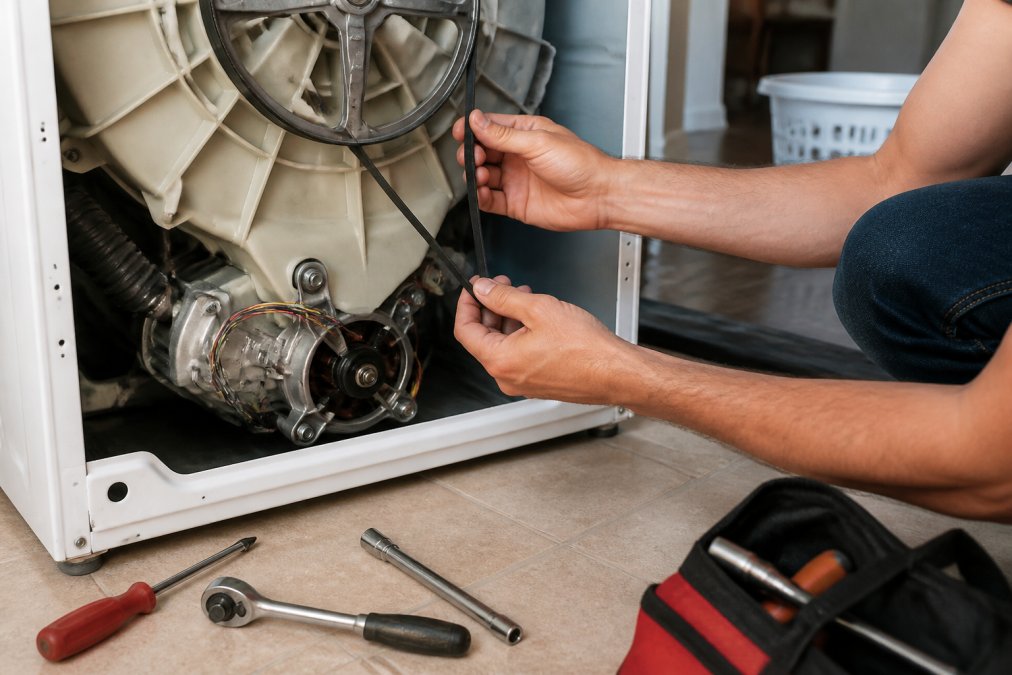
Check the belt for:
- Cracks, glazing, or fraying
- Slack that lets the belt slip
- A belt that has come off the pulley entirely
Washing Machine Lid Switch Replacement and Door Sensor Fixes
A washing machine lid switch replacement is one of the most common repairs on top-load machines, and it’s a job many homeowners can handle themselves.
If the lid switch or door latch tests fine but the washer still won’t spin, the problem has moved past the safety switch and into the control board or motor circuit.
Resetting the Control Board and Reading Error Codes
Sometimes nothing is broken. A control board that has glitched will lock out the spin cycle until you reset it. Other times, the machine is telling you exactly what’s wrong through a fault code, and most homeowners never read it.
How to Reset the Control Board
Start with the soft reset: unplug the washer or flip the dedicated breaker for a full 60 seconds, then restore power. This clears volatile memory and most temporary faults. If your machine has a diagnostic mode (often entered by a button sequence printed in your owner’s manual, commonly holding Start/Pause and a cycle button together for 3-5 seconds), enter it to pull stored error codes from the last several cycles.
Reading Spin-Related Error Codes
Error codes are the fastest diagnostic path on a modern washer, but the same code means different things across brands. The table below groups the categories of codes you’ll see when a washer won’t spin, along with the first thing to check. Always confirm the exact meaning against your model’s tech sheet, usually taped inside the control panel or behind the lower access panel.
| Code Category | What It Signals | First Diagnostic Step |
|---|---|---|
| Drain / pump fault | Water not evacuating in time | Clear the pump filter and check the drain hose for kinks |
| Lid / door lock fault | Safety switch not confirming closed | Test the lid switch or door latch assembly |
| Motor / drive fault | Motor not reaching target RPM | Inspect the drive belt, motor coupling, and motor windings |
| Balance / off-balance fault | Vibration sensor tripped | Redistribute the load and check the leveling legs |
| Communication fault | Control board not talking to the motor board | Reset the board; if it returns, the board or harness is failing |
| Water level / pressure fault | Pressure switch not reading correctly | Check the pressure hose for clogs or cracks |
What the Code Is Really Telling You
Write down the exact code before you reset. Once you clear it, the code is gone, and a technician will charge diagnostic time to reproduce it. A photo of the display is the single most useful thing you can hand a repair tech.
Error codes vary by brand and model year, so always check your model’s manual for exact meanings. As noted by the U.S. Consumer Product Safety Commission, appliances should be serviced with the correct replacement parts, and a manufacturer’s guide is the safest reference for your specific model.
Average Cost of Washing Machine Repair: DIY vs. Calling a Pro
The average cost of washing machine repair depends on the part and the labor involved. A lid switch or belt is a low-cost fix if you do it yourself. A failed motor or control board costs more, and the price climbs with the labor.
Typical Part Costs
Parts are the predictable half of the equation. Common spin-related parts generally fall into these ranges (prices vary by brand, model, and where you buy):
| Part | Typical Part Cost | DIY Difficulty |
|---|---|---|
| Lid switch | $15-$40 | Easy, 30-45 min |
| Door latch assembly (front-load) | $40-$90 | Moderate, 45-90 min |
| Drain pump | $30-$80 | Moderate, 45-60 min |
| Drive belt | $10-$30 | Easy to moderate, 30-60 min |
| Motor coupling | $10-$25 | Moderate, 45-90 min |
| Drive motor | $100-$250 | Hard, 2-4 hours |
| Control board | $150-$400 | Hard, 1-3 hours |
Typical Labor Costs
Professional labor for appliance repair commonly runs in the $75-$150 per hour range, with many companies charging a flat diagnostic fee (often $50-$100) that’s credited toward the repair if you approve the work. A simple lid switch swap might total $120-$200 out the door; a control board replacement can run $300-$600 or more depending on the part.
DIY vs. Pro: The Real Trade-Off
DIY makes sense when:
- The fix is a belt, filter, lid switch, or drain pump
- You have basic tools and a multimeter
- You can safely access the part and the machine is out of warranty
Calling a pro makes sense when:
- The motor, transmission, or control board has failed
- You’re unsure how to test electrical parts safely
- The machine is under warranty (DIY work can void it)
- The repair cost approaches half the price of a new washer
The Repair-or-Replace Math
Get the diagnostic quote in writing before authorizing work. A reputable shop will tell you the part cost, the labor estimate, and whether the diagnostic fee is credited toward the repair.
Pricing varies by make, model, and part availability, so it’s best to get a quote before committing. Tampa Bay Appliance Repair LLC offers free diagnostics with any repair, so you’ll know the problem and the price before work begins.
Preventive Maintenance to Avoid Future Spin Problems
Regular upkeep keeps the spin cycle working and heads off most breakdowns.
A simple maintenance schedule:
- Monthly: Run a clean cycle and wipe the door seal
- Every 3 months: Check the drain hose for kinks
- Every 6 months: Clean the drain pump filter
- Yearly: Inspect the drive belt and leveling legs
Keep loads balanced and don’t overload the drum. Most spin failures trace back to a machine that was pushed past its rated capacity one too many times.
Frequently Asked Questions
Why is my washing machine turning but not spinning?
If the drum turns during the wash cycle but won’t spin, the issue is usually a broken drive belt, a worn motor coupling, or a faulty lid switch. A top-load washer with a bad lid switch may agitate but refuse to spin because the safety switch never signals the control board that the lid is closed. Check the belt first, then test the lid switch with a multimeter before moving to the motor coupling.
How do I reset a washing machine to spin?
Unplug the washer for 60 seconds, then plug it back in. For most models, press and hold the Start or Pause button for 3 to 5 seconds to clear the control board. Some brands use a diagnostic mode, which you enter by pressing a specific button sequence listed in your owner’s manual. If the washer still won’t spin after a reset, the problem is mechanical or a failed component, not a glitch.
Is it worth fixing a washing machine that won’t spin?
It depends on the age and repair needed. A drive belt or lid switch replacement is inexpensive and usually worth doing on a machine under 8 years old. If the motor coupling, transmission, or control board has failed, the average cost of washing machine repair climbs significantly. Compare the repair quote to the price of a new washer, and consider replacing the unit if the repair exceeds half the cost of a new one.
How do I know if my washing machine motor is burnt out?
A burnt-out motor often smells like scorched wiring, makes a humming noise without turning the drum, or trips the electrical circuit breaker when you start a cycle. Test the motor with a multimeter set to resistance: if the windings show no continuity or infinite resistance, the motor has failed. A burnt motor is not a DIY fix for most homeowners and needs a licensed technician to replace.