

Table of Contents
- What Affects Fridge Compressor Replacement Cost
- Recognizing Refrigerator Compressor Symptoms
- How Long Does Refrigerator Compressor Replacement Take
- Refrigerator Repair vs Replacement Cost: Making the Decision
- Is It Worth Replacing a Refrigerator Compressor
- Warranty Coverage and What to Expect After Repair
- Conclusion
- Frequently Asked Questions
Last Updated: October 16, 2026
What Affects Fridge Compressor Replacement Cost
Fridge compressor replacement cost is a stack of line items, not one number. Knowing each lets you compare quotes instead of guessing whether a technician’s total is fair. The all-in bill for a residential refrigerator typically falls between roughly $400 and $1,200, with the compressor part and sealed-system labor doing most of the damage. The ranges below are typical U.S. market figures and move with your model, region, and access difficulty.
Compressor Part Cost
The compressor is the largest single line item because the part is matched to the refrigerator’s capacity and refrigerant type.
- Compact and mini fridges: smaller, lower-capacity compressors often land near the bottom of the range.
- Standard top-freezer and bottom-freezer units: mid-range parts, generally the most available and least expensive to source.
- French-door, side-by-side, and built-in models: larger or proprietary compressors push toward the top of the range, and some built-in units use parts priced well above $500.
Most replacement kits include the compressor, mounting gaskets, and sometimes a starting relay or overload protector. Confirm what is bundled before comparing prices, because a “cheaper” compressor that excludes the relay is not actually cheaper.
Labor and Service-Call Costs
Labor is the second-largest line item and varies most by market. A typical service call or diagnostic fee is often credited toward the repair if you approve the work. Ask before the technician arrives.
Compressor replacement labor itself varies, driven by:
- Access: a compressor behind a simple rear panel is faster to reach than one buried in a built-in cabinet.
- Sealed-system work: recovery, evacuation, and recharge require EPA-certified handling under Section 608 of the Clean Air Act, which limits who can legally do the job and adds time.
- Leak testing and pressure verification: skipping this step is how a repair fails in a few months.
- Local labor rates: metro areas with higher overhead charge more per hour than rural markets.
Refrigerant and Filter-Drier Charges
When the sealed system is opened, the refrigerant must be recovered and the system recharged.
The filter-drier is a small inline component that traps moisture and acid. It should be replaced every time the sealed system is opened. Leaving a saturated drier in place is a common cause of repeat compressor failure, so treat this as non-negotiable.
Other Materials and Add-Ons
Small parts add up. A starting relay, overload protector, or run capacitor may need replacement alongside the compressor. A restricted capillary tube or leaking evaporator found while the system is open adds cost on top.
Ask for an itemized estimate that separates the compressor, labor, refrigerant, filter-drier, and any add-on parts. A single lump-sum quote hides where the money is going and makes it impossible to compare two shops fairly.
Compressor Size and Type Differences
Compressor cost tracks capacity and technology. A small reciprocating compressor in a compact fridge is cheaper and simpler than a variable-speed inverter compressor in a modern French-door unit. Inverter compressors run at variable speeds for efficiency but cost more to replace and may require a matching control board, ask whether the board must be replaced at the same time, because that changes the total significantly.
Why Two Quotes for the Same Fridge Can Differ by Hundreds
The same refrigerator can produce quotes that differ by $300 or more. The usual reasons: refrigerant pricing, whether the shop bundles the filter-drier and relay into a flat rate, whether the diagnostic fee is credited, and how the shop handles the risk of finding a second problem once the system is open. Ask upfront what is included and what triggers an additional charge.
Recognizing Refrigerator Compressor Symptoms
Your compressor doesn’t fail without warning. The compressor cycles on when the fridge needs cooling and off when the temperature is right, and a failing one shows distinct patterns that differ from other refrigerator problems.
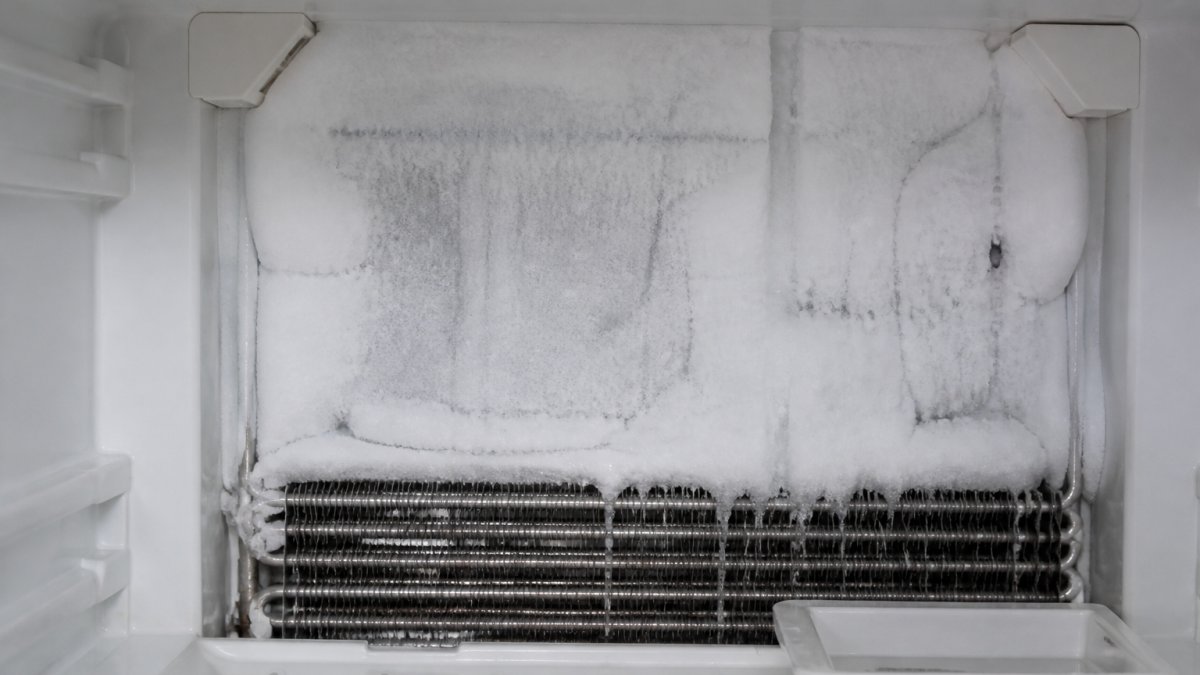
Signs your compressor is failing:
- Refrigerator runs constantly but doesn’t cool
- Food warms up despite the thermostat set to cold
- You hear no humming sound when the compressor should cycle on
- Compressor hums but the fridge doesn’t cool at all
Not every cooling problem means compressor failure. Clogged vents, failed thermostats, and blocked drain lines cause similar symptoms, so a proper diagnostic matters, a technician confirms the actual failure before you commit to replacement.
How Long Does Refrigerator Compressor Replacement Take
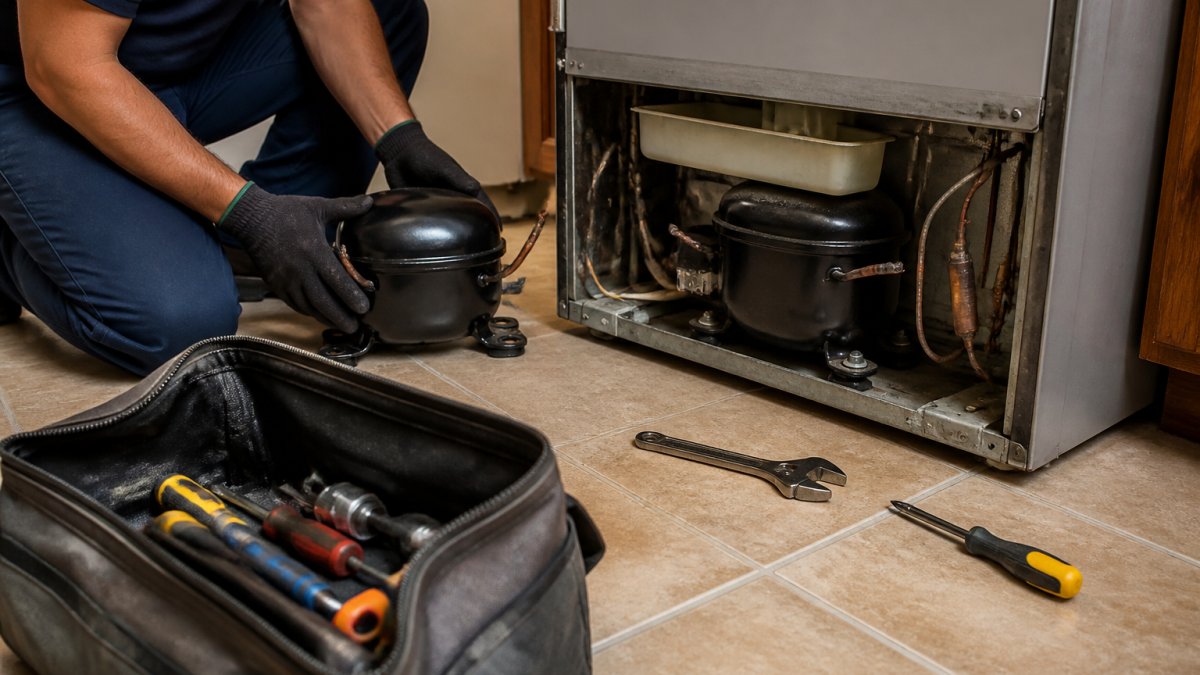
Most compressor replacements take between 2 and 4 hours, depending on your refrigerator model and how accessible the compressor is. Simple jobs with easy back-panel access run closer to 2 hours; complex replacements where the compressor sits deep inside the cabinet can stretch toward 4 or 5 hours.
The technician must:
- Recover existing refrigerant safely
- Remove the old compressor
- Install the new unit
- Evacuate air from the sealed system
Same-day service is possible for many repairs, though emergency or after-hours work typically costs more. A refrigerator without cooling loses food safety in 4 hours, so scheduling quickly prevents waste.
Refrigerator Repair vs Replacement Cost: Making the Decision
Fix it or buy new? The answer depends on a calculation, not a feeling. Here is a framework you can run in about five minutes using your actual repair quote and a realistic replacement price.
Step 1: Get a Real Replacement Number
Before comparing, you need to know what a comparable new refrigerator actually costs. Rough market guide:
- Compact and mini fridges: roughly $150 to $400
- Standard top-freezer units: roughly $600 to $1,100
- Bottom-freezer units: roughly $900 to $1,600
- Side-by-side units: roughly $1,200 to $2,200
Add delivery, haul-away of the old unit, and any installation or water-line hookup. That total, not the sticker price, is your true replacement cost.
Step 2: Get an Itemized Repair Quote
Use the itemized estimate described earlier: compressor part, labor, refrigerant, filter-drier, and any add-on parts. A lump-sum number is not enough.
Step 3: Run the Ratio
A common rule of thumb among appliance technicians is the 50% rule: if the repair cost exceeds half the price of a comparable new refrigerator, replacement usually wins.
Worked example: a 9-year-old French-door refrigerator with a $900 repair quote against a $1,800 replacement. The repair is 50% of replacement, right at the line.
Second example: a 4-year-old top-freezer with a $450 repair quote against a $900 replacement.
Step 4: Factor in Age and Expected Remaining Life
Most refrigerators last roughly 10 to 15 years, though that varies by brand and workload. Use age as a tiebreaker:
- Under 7 years old: repair usually wins if the compressor is the only major failure.
- 7 to 10 years old: the ratio matters most; a repair under 40% of replacement is usually worth it.
- Over 10 years old: replacement becomes attractive even at a lower repair ratio, because the next failure is likely close behind.
- Over 15 years old: replacement almost always wins. Parts are harder to source, efficiency is poor, and a second major failure within a year is common.
Step 5: Weigh the Hidden Costs
Three costs don’t show up in the repair quote but should influence the decision:
- Energy use: older refrigerators consume noticeably more electricity than current ENERGY STAR models (Refrigerators). Over several years, the utility savings from a new unit can offset part of the purchase price.
- Food loss: a failed compressor means spoiled food. A repair that takes days to schedule and complete can cost more in groceries than the repair itself.
- Repeat repairs: if the refrigerator has already had two or more repairs in the past few years, the odds of another failure rise sharply.
If your repair quote is between 40% and 60% of replacement cost and the refrigerator is 7 to 10 years old, the decision is genuinely close. In that band, ask the technician directly: “If this were your refrigerator, what would you do?” A straight answer is more useful than any formula.
When Repair Clearly Wins
- The refrigerator is under 7 years old.
- The compressor is the only major failure.
- The repair quote is under 40% of a comparable replacement.
- The unit has a good reliability history with no prior major repairs.
When Replacement Clearly Wins
- The refrigerator is over 10 to 12 years old.
- The repair quote exceeds 50% of a comparable replacement.
- The compressor failure comes alongside other failing components.
- Parts for your model are discontinued or hard to source.
The Bottom Line
There is no universal answer, but there is a repeatable process: get a real replacement number, get an itemized repair quote, run the ratio, adjust for age, and weigh energy and food-loss costs. That gives you a defensible decision even when the numbers land close to the line.
Is It Worth Replacing a Refrigerator Compressor
Whether replacing a refrigerator compressor makes financial sense depends on your situation, not general rules.
Calculate the true cost:
- Compressor part and labor
- Refrigerant and filter-drier
- Any additional repairs discovered during work
- Your refrigerator’s age and reliability history
Then compare that total to the cost of a new refrigerator. If repair is less than 40% of replacement cost, repair usually wins.
Age matters most.
At Tampa Bay Appliance Repair LLC, we give homeowners honest assessments. The goal is helping you make the choice that saves money and frustration over time.
Warranty Coverage and What to Expect After Repair
Most compressor replacements come with a parts warranty covering the new compressor itself, typically 1 to 5 years depending on the manufacturer and part quality.
What warranty covers:
- Defects in the compressor motor
- Failure of the sealed system
- Manufacturing flaws in the replacement part
What warranty does NOT cover:
- Damage from improper installation
- Electrical surges or power issues
- Refrigerant leaks caused by user damage
- Normal wear and tear
Many repair shops also offer labor warranties covering workmanship: if the repair fails due to how it was done, not the part itself, they’ll fix it at no charge.
After replacement, your refrigerator should cool normally, cycle on and off as designed, run quietly, and return to normal energy use.
Conclusion
Understanding fridge compressor replacement cost means knowing what you’re paying for: the part itself, the labor to install it safely, the refrigerant and filter-drier charges, and the technician’s expertise.
At Tampa Bay Appliance Repair LLC, we offer free diagnostics with repair to confirm the actual problem. Our EPA-certified technicians explain your options clearly.
Book online with Tampa Bay Appliance Repair LLC today. Let us diagnose your refrigerator’s cooling problem and give you an honest estimate before any work begins.
Frequently Asked Questions
How do I know if my refrigerator compressor is actually the problem?
The compressor is the motor that keeps your fridge cold. If your refrigerator stops cooling but the motor runs (you hear it humming), the compressor may have failed. Other signs include the fridge warming up over hours, the motor running constantly without stopping, or a loud grinding noise from the back of the unit. A qualified technician can confirm compressor failure with diagnostic tools, don’t assume the compressor is bad without proper testing, as other sealed-system components (like the capacitor or contactor) can cause similar symptoms.
Is it worth replacing a refrigerator compressor, or should I buy a new fridge?
The answer depends on the age and condition of your refrigerator. If your fridge is under 7 years old and the compressor is the only problem, repair usually makes financial sense. If your refrigerator is 10+ years old, has other failing parts, or already needed repairs recently, replacement may be more cost-effective long-term. Calculate the total repair cost (compressor part, labor, refrigerant) and compare it to the price of a new unit. Also consider that a repaired compressor typically comes with a limited warranty, whereas a new refrigerator carries a full manufacturer warranty.
What’s included in the total cost of refrigerator compressor replacement?
The total cost includes the compressor part itself, labor (usually 1-3 hours depending on model access), a service-call fee (if applicable), refrigerant recharge, and often a filter-drier replacement to remove moisture from the sealed system. Some technicians bundle the diagnostic fee into the repair cost if you proceed with the work. Always ask for an itemized estimate before work begins so you understand exactly what you’re paying for and can make an informed repair-versus-replacement decision.
How long does refrigerator compressor replacement take?
A straightforward compressor replacement typically takes 1-3 hours, depending on your refrigerator model and how accessible the compressor is. Some units require removal of the back panel or interior components, which adds time. The technician also needs time to evacuate old refrigerant, install the new compressor, recharge the system, and test cooling function. Expect the appointment to last 2-4 hours total, including diagnostics and cleanup.